
Muri is one of the three types of waste (Mura, Muri, Muda,) and a key component to the Toyota Production System.
Overburdening equipment or operators by requiring them to run at a higher or harder pace with more force and effort for a longer period of time than equipment designs and appropriate workforce management allow.
Muri causes Muda, the seven wastes are symptoms of our failure to tackle Mura and Muri within our processes.
Meaning of Muri

-Unreasonableness; impossible; beyond one’s power.
-Too difficult; by force; perforce.
-Forcibly; compulsorily; excessiveness; immoderation.
-Overburden or unreasonableness.
Examples of Muri
Tackling the Muri within a process should ensure that workers can work far more efficiently and with minimal stress within your processes. Limited examples below:
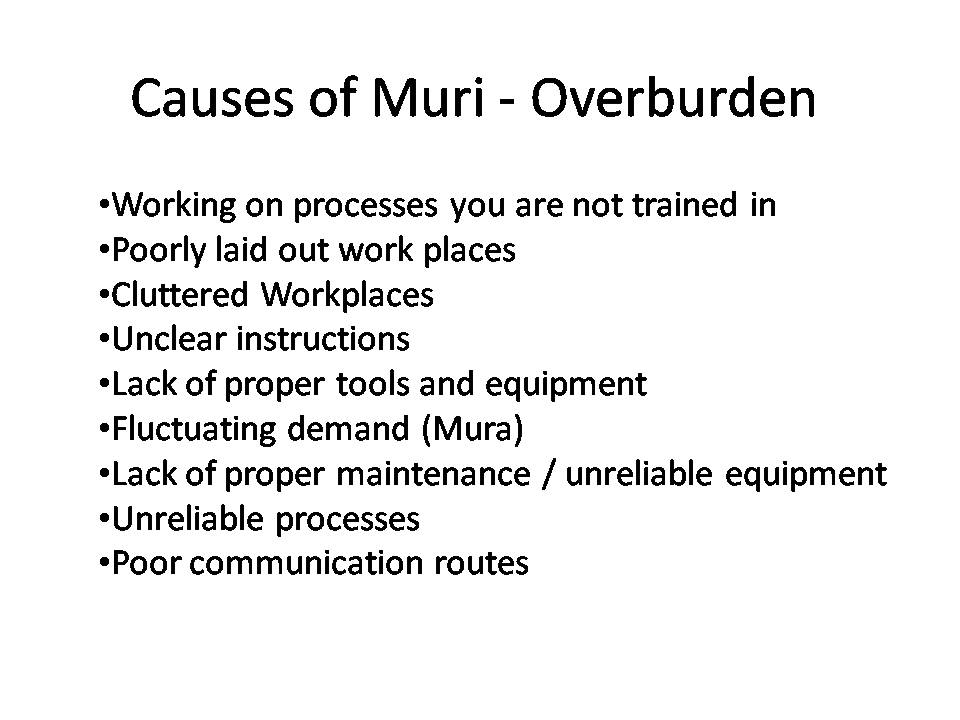
-Working on processes you are not trained in.
-Poorly laid out work places.
-Unclear instructions.
-Lack of proper tools and equipment.
-Fluctuating demand (Mura).
-Lack of proper maintenance / unreliable equipment.
-Unreliable processes.
-Poor communication routes.
How to Avoid Muri

Standardistaion:
To achieve this a standard condition or output must be defined to assure effective judgment of quality. Then every process and function must be reduced to its simplest elements for examination and later recombination. The process must then be standardised to achieve the standard condition. This is done by taking simple work elements and combining them, one-by-one into standardized work sequences.
Standardised Benefits
When everyone knows the standard condition, and the standardised work sequences, the results observed include:
-Heightened employee morale (due to close examination of ergonomics and safety).
-Higher quality.
-Improved productivity.
-Reduced costs.
How to Achieve Standardisation
5S:
Performing the 5 steps to this process will be help to create a workplace suited for visual control and lean production by enabling waste elimination, standardistion and continuous organisation of the workplace.
Map the Value Stream:
Through a Kanban visualistaion method. If working with a team, understand the work required and add it to the Kanban board. Map the steps from start to complete through columns.
WIP:
Muri exists when worker(s) are utilised for more than 100% capability to complete a task or in an unsustainable way. Understand the worker(s) capacity then implement work in progress (WIP) limits to control the flow of work. This will level the process out and allow the worked to be pulled in when needed, instead of be pushed in.
Jidoka:
Everyone within the process should be empowered to stop the process when things are not correct, this should be fully supported and everyone should become involved in solving the problems that get highlighted rather than expecting people to live with problems all of the time just to get the numbers out.
Stress on The Workers

Every time when you put your team under stress by demanding unreasonable or unnecessary work that exceeds their capacity. Muri over a period of time can result in employee absenteeism, illness, and breakdowns of machines.

Basketball Team – Muri

It is like in a basketball team: if you only put the whole pressure on 3 players because they are really good at some point they will get injured and then the whole team will struggle. So you need to be careful while trying to use the full capacity of your team. I’m tempted to give the example of the Chicago Bulls when Michael Jordan played. He steered the team but relied on Scottie Pippin who one year got injured. Indeed Michael left to play baseball at one point and the team had to adapt without their star player.